Showing posts with label eddington. Show all posts

Friday, November 11, 2011

Good mornin'


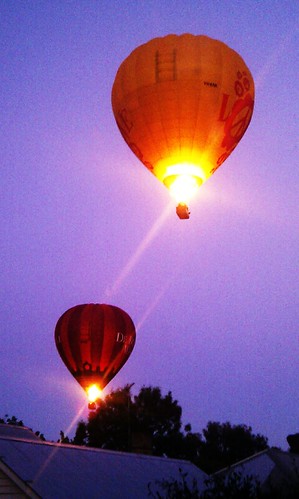
It's been some time since I've seen balloons launching from JJ Holland Park. Perhaps I just haven't been waking early enough. But, it was a very pleasant way to greet the day. Well, pleasant until I saw this.

INFRASTRUCTURE consultant Sir Rod Eddington yesterday urged the Baillieu Government to build an east-west toll road under the city.

Sir Rod said the tunnel, which he proposed in 2008, should be the priority for this state.

"It would be a project that the private sector would very definitely be interested in participating in," he said.

"That means, rather like the Domain and Burnley tunnels, it would be a tolled facility."

Sir Rod, chairman of federal government advisory group Infrastructure Australia, told the previous state government in a report that Melbourne needed a tunnel linking the Eastern Freeway with the Western Ring Road.

Speaking yesterday at a Committee for Melbourne event, the businessman said governments needed private sector support to deal with traffic congestion.

"We have demonstrated here that good toll roads work and we should build more of them," Sir Rod explained.

http://www.heraldsun.com.au/news/more-news/sir-rod-pushes-for-east-west-toll-road/story-fn7x8me2-1226191845178

Number 1 priority? I think priorities numbered 1 through 26 inclusive should revolve around our rail system. Getting more cars off the roads is the single best thing you can do to aid with traffic flow. Also removing the level crossings and providing grade separation between rail and road. Fix up the existing network (switching, timetabling). Create new lines to service Melbourne's sprawl, instead of expecting the overloaded road system to be able to handle it.

None of that is easy. It would take a lot of time, and a lot of disruption. But in the end, it is an investment in our city, instead of another band-aid stop-gap measure of yet another freeway (sorry, tolled road link) which would become a car park and/or further choke any areas serviced by its off-ramps.

But now, I think I'm going to go and enjoy the sunshine.

Tuesday, June 1, 2010

Funding plea puts east-west tunnel back on agenda - Melbourne Leader


A BRUMBY Government submission to Canberra shows Spring St is actively pursuing a road tunnel from Kensington to Clifton Hill, residents claim.

The project was first mooted in the 2008 Eddington report, but community backlash forced the government to back away from any immediate plans when it released its $38 billion Victorian Transport Plan later that year.

However, a Spring St submission to the Federal Department of the Environment indicates the tunnel would follow the completion of the $3.5 billion Westlink project, which is expected to begin in 2013.

The submission was seeking the department’s permission to proceed with the project linking Western Ring Rd with Kensington via Sunshine Rd and a new tunnel under Footscray.

The document refers to Westlink as the “immediate priority” in a “three-stage” proposal to build an 18km link between Melbourne’s western suburbs and the Eastern Freeway in accordance with the Eddington Report.

The east-west tunnel was a cornerstone of Sir Rod Eddington’s report, titled Investing in Transport...

Read the rest here - http://melbourne-leader.whereilive.com.au/news/story/funding-plea-puts-east-west-tunnel-back-on-agenda/


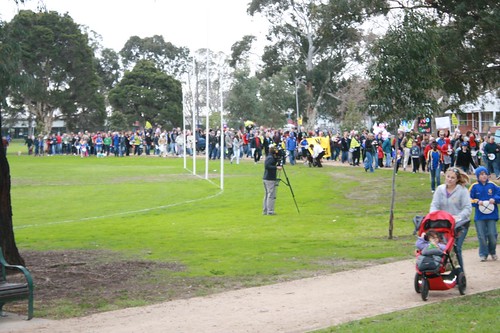
The stream of angry residents converging on the suspected site
of where the tunnel would come out.

Friday, November 21, 2008

Trading in ConnectEast shares frozen as toll road fails to fire - TheAge

FAR fewer drivers are using EastLink than predicted, forcing operator ConnectEast to freeze trading in its shares while it raises money to cover its $1.9 billion debt.

Fewer than 150,000 trips a day are being made on the road.

When it offered shares in the toll road in 2004, ConnectEast predicted it would have 225,000 trips a day by this stage.

Industry analysts say the road must generate at least 156,000 trips a day to cover an interest bill of about $15 million a month. But despite the road's poorer-than-expected performance — CitiGroup last month described ConnectEast as "a looming default risk" — it is the third-busiest route in Victoria.

The Ringwood end of the road is carrying near the levels of traffic predicted. But to the south, near where the State Government wants to build the Frankston bypass, traffic drops off.

Premier John Brumby, who will release the Victorian transport plan next month, has signalled he will support building the $700 million Frankston freeway.

But the performance of EastLink will cast further doubt on the viability of a $9 billion tolled tunnel from Footscray to Clifton Hill, as proposed by Sir Rod Eddington. The credit squeeze has heightened dramatically since Sir Rod's $20 billion transport plan was released in April.

Road builders and operators are shying away from big projects, with ConnectEast and Transurban telling The Age this month they were not interested in major new projects. ConnectEast has requested that the Australian Securities Exchange freeze trade in its shares until Monday next week, while it raises as much as $450 million from investors.

Before the freeze, the shares were trading at 67 cents. When ConnectEast was floated in 2004, its shares were worth $1.

But the drop is minor in comparison to BrisConnections, the company that started building a $4.8 billion Brisbane toll road this month.

Investors paid $1 for shares in the seven-kilometre airport link in June, and must shell out another $2 in the next 18 months to keep them. The shares were worth just 0.1 cent yesterday.


Read the entire article at TheAge.com.au

Analysis of the Eddington Report Submissions

Kate Wilson, from The University of Melbourne, has conducted a detailed analysis of all 2149 submissions that were forwarded to the Department of Transport, in response to the East-West Link Need's Assessment, often called the 'Eddington Report'.

Take a look at it here (pdf). Below are a few key quotes.

4.9 Specific Issues
According to Eddington: “The EWLNA Study Team has also assessed the environmental impacts of all options considered by the study, as well as giving close attention to issues of community and neighbourhood amenity.”47 Kensington in particular feels like this has not been the case as JJ Holland Park is a proposed construction site for the east-west tunnel. The destruction of JJ Holland Park was the single biggest specific issue from the submission process. Submissions were received from children and their parents, sporting clubs using the park and community organisations. The Kensington Association is concerned with specific impacts the tunnel would have on JJ Holland Park and “strongly opposes to the use of JJ Holland Park as a staging point for any construction, or as an exit for the road tunnel proposed in Recommendation 4.”48 Many different groups and individuals use the park for passive and structured relaxation and leisure activities and if the use of the park goes ahead it will result in a backlash for the Brumby Government. Similarly, Royal Park in Parkville also mobilised mass community support for the park and was a big issue for a number of submissions....


And from the conclusion...

The obvious conclusion to be drawn from the submissions is that there is widespread opposition to the tunnel. Almost 78 percent of submissions were opposed to the tunnel compared with almost 8 percent who were in favour of it. Individual submissions were overwhelmingly against the tunnel, with 93 percent of them opposing it. Opposition for the tunnel was based primarily on the need for public transport instead of more roads and the impact of the tunnel on climate change. Specific issues were the next biggest contender, in particular the use of JJ Holland Park in Kensington as a staging point for construction of the tunnel was met with widespread opposition.

Wednesday, September 10, 2008

'Your Say' - document from Premier's Transport Summmit


Click here for a copy (pdf) of the document summarising the responses on the Eddington Report, that was distributed at last Friday's Transport Summit, held by the Premier.

Tuesday, September 2, 2008

Transport giants back multi-billion-dollar roads strategy - news.com.au

VICTORIA'S biggest transport companies have backed construction of a $9.5 billion road tunnel through the city's inner north.

The Herald Sun has seen submissions on the proposal by international transport expert Sir Rod Eddington to build Melbourne's biggest infrastructure project.

Toll road operator ConnectEast, trucking giant Linfox, the RACV and the Transport Workers Union are adamant new roads must be built to cope with the state's population spurt.

ConnectEast, operator of Melbourne's newest toll road EastLink, says it wants to build the tunnel and claims it can be done at no cost to the Government.

But it would come at a cost to motorists - more tolls...

Read the entire article at News.com.au (of which, Sir Rod Eddington is a board member), and read the always informed comments of the Herald Sun readers here.

Friday, August 29, 2008

Speak out on Melbourne's transport crisis, urges Sir Rod Eddington - news.com.au

by Ashley Gardiner

TRANSPORT expert Sir Rod Eddington has warned that Melbourne's congestion crisis will not be fixed if those who oppose his ideas dominate the debate.

Sir Rod last night called on those who would benefit to speak out.

"If we don't participate in the debate, then we shouldn't be surprised if we don't get what we want," Sir Rod said.

"The problem with the debate is, unless you're careful, the debate leads to complete inactivity."

Melbourne's transport problems would only be solved by investment in new infrastructure, he said.

"That is both expensive and disruptive," Sir Rod said.

"That means there will be people who will be disrupted, and it's tough for them, and they will quite rightly make their views known."

Sir Rod said that disruption had to happen to improve the situation, particularly in areas where transport connections were poor.

"If those who face disruption are vigorous in their complaint, and those who will benefit from all the things that (could be) done say nothing, then don't be surprised if the first group prevail."

The underground City Loop was a hugely disruptive project when built in the 1970s and '80s.

"I can remember it turned up the streets of Melbourne for quite some time," Sir Rod said.

"It was an essential and necessary part of providing a better life for everyone ultimately, but it does mean some people face temporary disruption."

Sir Rod was speaking at Monash University's annual Ogden Transport Lecture at the State Library last night.

Activists are already mobilising campaigns against the proposals made by Sir Rod this year.

They include a road tunnel linking the Eastern Freeway to the western suburbs and a rail link from Caulfield to Footscray.

Residents around Kensington are campaigning against the potential loss of a park that would be used as a works site during construction.

Opposition is also mounting in the western suburbs in areas where the link may be situated.

The State Government is nervous about the electoral implications of the projects.


Read the original article at news.com.au

Funnily enough, I agree that people need to speak out, and I agree that Melbourne needs massive spending on infrastructure. I guess it's which infrastructure, and what people need to speak out about that we disagree upon.

Remember, email yoursay@dot.vic.gov.au if you want to send your personal suggestions to the State Government.

Friday, July 25, 2008

Eddington: visionary and plodder

Another extremely well-written article, worth the read.

NOW that submissions to the Eddington report into east-west travel needs have closed, the Brumby Government must decide its response.

Eddington proposes billions of dollars of investment in what is trumpeted as an integrated package of major transport infrastructure projects - take away one component, and the plan collapses.

A careful reading of the report reveals that that is not the case: the proposal is actually an amalgam of two quite different approaches to transport planning. One is little more than "business as usual" road planning; the other a visionary solution to Melbourne's public transport crisis. The Government can choose one or the other, but not both.

The rationale of the study is first to resolve current big problems with the transport network; then to move beyond the traditional "predict and provide" method to explore new connections needed to make the city more sustainable. The "city shaping" power of new, large-scale projects is emphasised.

However, the report reverts to more traditional transport analysis techniques after this initial flourish. A whole chapter is devoted to advancing the argument that there is latent demand for a new east-west route crossing the Maribyrnong River. Latent, because the counts at the Eastern Freeway exit fail to justify such a link. Evidence of need has been inferred from screen counts as far afield as Brunswick and the CBD.

This "predict" analysis takes little or no account of the impact of anticipated federal climate change initiatives that will arise from the Garnaut process. Nor does it give weight to current state policies aimed at improving the sustainability of the metro-urban form, such as Melbourne 2030.

There is no choice, say the road planners: latent demand requires building more road capacity. This is "predict and provide" in all but name.

How, then, is public transport need assessed in the report?

The public transport authors seem to have a completely different perspective to their road engineer colleagues. Their chapter states: "… making forecasts and then shaping the system to meet them is self-fulfilling. If no system capacity or operational changes are made, patronage will inevitably plateau at capacity; making more system enhancements and improving the service will attract more people."

In other words, "predict and provide" attracts more patronage. Providing additional capacity costs a lot of money. So, choices need to be made about how much capacity to invest in.

In the public transport world, the "predict" part of the equation seems to be harder to argue for than it is for the road planners. The predictive model the Eddington team used, combining historical data with the latest demographic forecasts, produced a predicted growth in public transport equivalent to 2.1% a year, far lower than recent trends. In what seems like a circular argument, this low rate of growth is explained by the absence of major new infrastructure to increase rail capacity.

Fortunately the Government's public transport division stepped in and proposed that a more realistic and up-to-date growth rate (6.6% a year) be adopted. This becomes the basis for the rail tunnel and related proposals.

The most pressing rail capacity need, according to the public transport planners, is in the northern group of lines, largely as a result of rapid growth in the west, north-west and northern suburbs. On the basis of recent trends, peak patronage on these lines will more than double by 2021 to 45,000.

The same planners drop hints that they are working on a long-term vision for Melbourne's rail network that will transform it into a modern metro system. At present, lines radiate outwards from the CBD like branches of a tree, through capacity-constraining junctions like North Melbourne. The emerging vision seems to involve each line becoming a self-contained, end-to-end route diving under the CBD, with a simplified, much more frequent level of service - rather like the London Tube or Paris Metro. The East-West rail tunnel would be a bold first step along that path.

Add to this the inventive proposal to re-route V/Line trains from Geelong to join the Ballarat line near Rockbank, which in turn joins the Bendigo line at Sunshine. All three V/Line services would then feed into widened tracks at Sunshine-Footscray. This would remove further chronic capacity constraints in the metropolitan train system, and speed up the country services.

These imaginative proposals make sense as a first stage in a radical plan to improve the whole of Melbourne's rail infrastructure. The irony is that they are first seeing the light of day in a road study that focuses on east-west movement in inner Melbourne. Indeed, this limited brief is a fundamental flaw in the Eddington report; and no fault of its author, who has been at pains to point it out.

In effect, what has been delivered is a road plan aimed at resolving a specific network issue in inner Melbourne, into which has been inserted the beginnings of a visionary plan

to transform the capacity of the entire metropolitan rail system. The tunnel solution (one for road, one for rail) is the common denominator. In most other respects, the report's road and public transport analyses are poles apart.

So, how should east-west travel needs be approached in Melbourne?

The crux of a solution appears 100 pages into the report. After an admission that it is not possible or realistic to eliminate road congestion altogether comes the statement: "Some form of congestion-targeted road charging is inevitable in Melbourne, although this may be a decade or more away." The question is not if, but when, congestion charging should be introduced. "Melbourne needs to be much better prepared to take this step when required," says the report.

This surely is the challenge that a credible road plan for Melbourne must tackle, yet the Eddington report completely fails to engage it.

How would such a charge affect peak hour travel habits? Will people gradually move to live closer to their workplaces? How many will transfer to public transport? What about walking and cycling? Especially, how would such a charge affect the traffic projections for the east-west road tunnel, a hugely expensive undertaking that has a negative cost-benefit ratio even without taking congestion charges and climate change policies into account?

The answer is: we don't know; the Eddington report does not even ask these questions. This is a scandalously inadequate basis on which to be considering the outlay of $10 billion for a road tunnel.

The east-west road study in many ways perpetuates the incremental approach to road building that has bedevilled Melbourne for 40 years.

Eddington's rail proposals, by contrast, provide for the first time the beginnings of a credible transport response to climate change and sustainable city form across Melbourne. Of course we need to add greatly improved bus services, and we need a big shift towards bikes and walking for short trips. A program of suburban rail extensions is another urgent priority.

The Federal Government seems to be taking climate change seriously and has said it will reinstate funding for urban public transport. The State Government says it will release a new transport plan later this year.

In its response to the Eddington report the State Government should seize the moment to initiate a new approach to transport planning in Melbourne. It should mark the end of incremental, demand-led road planning predicated on "business as usual" travel patterns. It should instead signal the beginning of an era in which transport investments are justified with reference to the sustainability and liveability of this city and the people who live and work in it.

Mike Scott is a director of Melbourne planning consultancy Planisphere. Last year one of his projects won the main Planning Institute of Australia award. He is a former director of city strategy at the City of Melbourne.

Read the original article at TheAge.com.au

Tuesday, July 8, 2008

John and Rod have a chat

Interesting this is released with one week to go before the submissions from the public are closed.

Premier John Brumby and Sir Rod Eddington selling the proposal...


Oh... and of course...

Or if you have low bandwidth, click here for a transcript

Remember, register here NOW if you are available online from 9:30-12 noon this Friday, Jul 11th, to participate in the State Government's Online Eddington Forum

Monday, June 23, 2008

Sorry, Sir Rod, your rail tunnel plan is just loopy

IT'S been a long time between drinks for advocates of rail in Melbourne. The last new suburban line was the Glen Waverley line, which opened in 1930. It was to be followed by one to Doncaster, but the Depression and war intervened. Since then, plans for links to Monash University, Rowville and Melbourne Airport have also come to nothing.

But things may be changing. A new Prime Minister has begun talking about urban rail and, after decades of decline, patronage is growing again.

Enter Sir Rod Eddington. His report on east-west transport proposes the biggest capital expenditure program in Australian history. Half the $18 billion is for a single road project, which Eddington's own consultant economists suggest has a benefit-cost ratio well below one — which in plain English means it's a waste of money.

The other major project is a rail tunnel from Footscray to Caulfield, and Eddington has been talking up this aspect. He has criticised, without naming, people who have questioned the need for the rail tunnel. He describes this questioning as "dangerous nonsense", a stance echoed by Melissa Fyfe in The Sunday Age last week.

How could supporters of public transport question the wisdom of spending $8.5 billion on rail? Isn't it time Melbourne put serious money into an underground line to enable more trains to run to the city centre?

The simple answer is that Melbourne has already done just this. That's what the City Loop, which cost $5 billion in today's money, was all about. It's set out in the 1969 Melbourne Transportation Plan, which shows the system was intended to handle much higher volumes of trains and passengers than it carries today. There were to be new lines to places such as Doncaster and Rowville, more frequent services and more expresses.

Annual patronage was supposed to reach 300 million by 1985; in fact, this year it might reach 200 million. The number of suburban trains arriving at Flinders Street in the busiest hour was to jump from 108 in 1964 to 181 in 1985; instead, it's fallen to 95. There was to be an express from Mordialloc every two minutes in peak hour; instead there's one a day.

One reason patronage is lower than anticipated is that none of the proposed suburban lines were built because the loop chewed up all the available funds. The priority now should be to start work on those long-overdue new lines, plus electrifying existing routes to places such as Caroline Springs and Melton.

But Eddington is proposing that nothing be done to serve these areas. He wants to spend all available money on a rail tunnel that will duplicate the one we already have and which won't be finished until at least 2019, giving rail managers an excuse for another decade of inaction.

What reasons does Eddington offer for not utilising the spare capacity on the system? His report does not discuss the issue at all. Instead, it compares Melbourne's rail system with the way it operated in the 1930s, showing that we now run more express services. So what? We run far fewer expresses than the loop was designed to handle, as the 1969 plan shows.

The problems that are clogging the system are set out in a consultants' report that, although available on the Eddington website, is not discussed in his report. The Transport Supply and Demand report shows there are eight in-bound tracks serving Flinders Street: four running via the City Loop, and four "direct". Each is signalled to handle a train every two minutes, or 30 an hour. This would allow a total of 240 trains an hour, but international best practice suggests running at 80% to maintain reliability. That's 192 trains an hour, or twice the current level.

The real problem is not in the Loop at all: it's in the Department of Transport and Connex. The consultants outline the poor operating practices preventing available capacity from being used, ranging from crew changes delaying trains at Flinders Street to poor internal carriage layout slowing boarding. Instead of fixing the problems, Eddington proposes giving the department $8.5 billion to duplicate the Loop, along with an excuse for doing nothing else for a decade.

That's why Eddington has missed the train.

Paul Mees is a senior lecturer in transport planning at RMIT.

http://www.theage.com.au/opinion/sorry-sir-rod-your-rail-tunnel-plan-is-just-loopy-20080621-2uke.html?page=-1